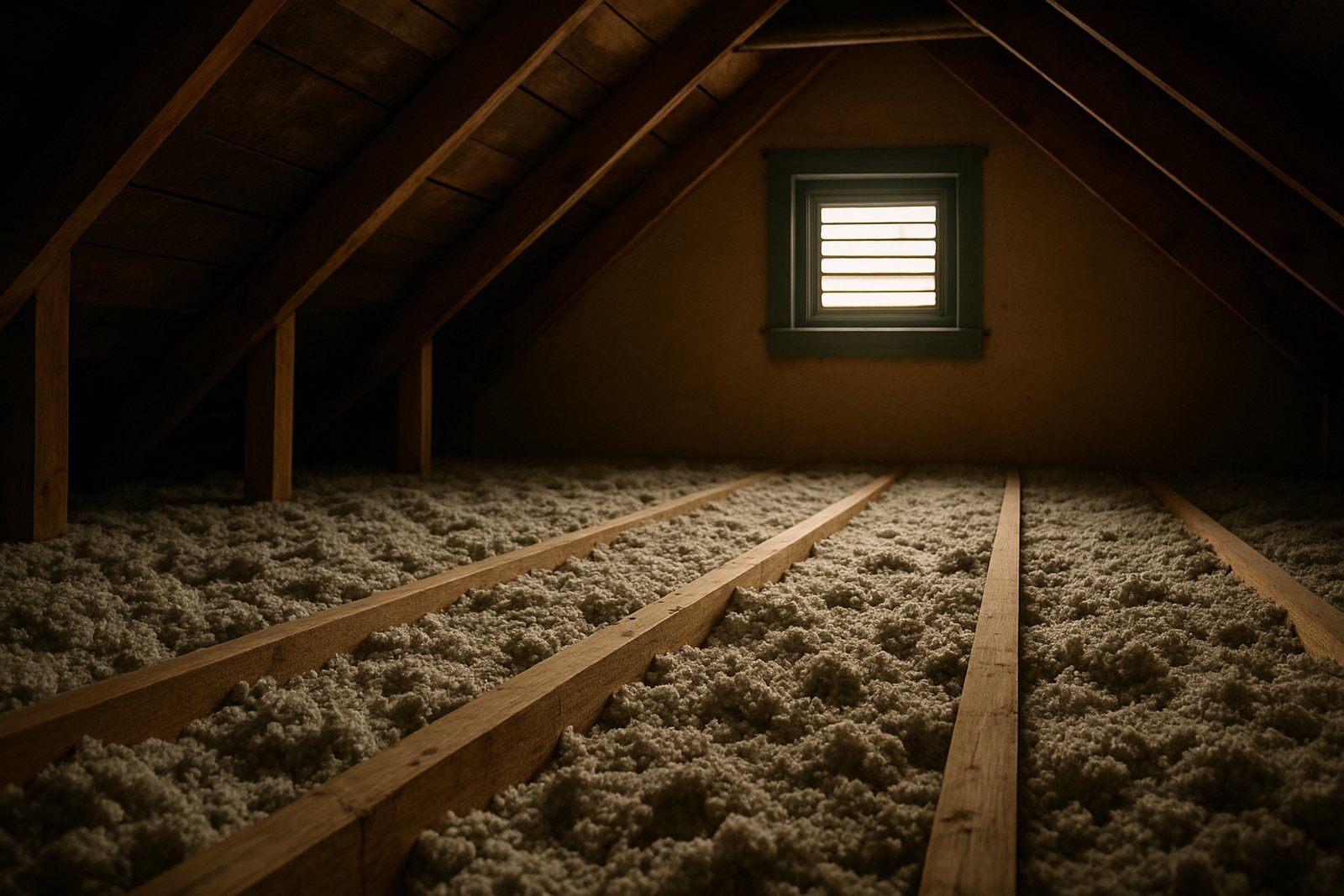
Insulation & air sealing
Attic Insulation Guide: How Much R-Value You Need and What It Costs
How much attic insulation you need by climate zone, how to check what you have, which material to choose, DIY vs pro, and why to air seal first.
Topics
How much insulation should you add to your attic? Measure the depth you have now, pick your climate zone and material, and see your current R-value, the recommended level and the inches to add.
Updated · Free, private: nothing you type leaves your browser.
Your results
You have about R-10. To reach R-60, add about 13.5 in of the material you chose (17.5 in in total).
Estimate only. Uses the assumptions explained below.
R-value measures how well insulation resists heat flow. The higher the number, the better it insulates. The calculator estimates your current R-value from the depth and type of insulation you have, compares it with the recommended level for your climate zone, and works out the inches of new material needed to close the gap.
Current R-value   = current depth (inches) × R per inch of current material
R-value to add    = recommended R-value − current R-value   (not less than 0)
Inches to add     = R-value to add ÷ R per inch of new material
Total depth       = current depth + inches to add
Volume to add     = inches to add ÷ 12 × attic floor area   (cubic feet)
R per inch. The tool uses the multipliers from ENERGY STAR’s do-it-yourself insulation check: loose-fill fiberglass 2.5, loose rock wool 2.8, fiberglass batts 3.2, and loose-fill cellulose 3.7.
Recommended R-value. The target is ENERGY STAR’s recommendation for an uninsulated attic in each climate zone: R-30 in zone 1, R-49 in zones 2 and 3, and R-60 in zones 4 through 8.
ENERGY STAR also publishes a lower figure for attics that already have 3 to 4 inches: R-25, R-38 or R-49 depending on the zone. By default the calculator aims for the higher, uninsulated-attic level. If budget is tight, choose the add-to level in the Target level setting; it is a reasonable first goal.
| Climate zone | Uninsulated attic (default target) | Attic with 3–4 in. already |
|---|---|---|
| 1 | R-30 | R-25 |
| 2 and 3 | R-49 | R-38 |
| 4A, 4B, 4C, 5 and 6 | R-60 | R-49 |
| 7 and 8 | R-60 | R-49 |
Source: ENERGY STAR recommended home insulation R-values.
The default case is a 1,200-square-foot attic in climate zone 5, the Midwest or southern New England.
A 1,500-square-foot attic in zone 3, in the Southeast, has 6 inches of fiberglass batts. The homeowner plans to add loose-fill fiberglass.
If this homeowner aimed instead for ENERGY STAR’s R-38 level for attics that already have some insulation, the job would be smaller. Change the zone or depth in the tool to compare.
“Inches to add” is the settled depth of new material you need. Installers and product labels work in R-values and bag counts, so use the R-value target when you talk with a contractor or buy material. Product bags list the bags per 1,000 square feet and the minimum settled thickness for each R-value.
The volume figure helps you sanity-check a quote or plan a do-it-yourself job, but it is not a bag count. Loose-fill is sold by weight, and coverage differs by product.
Insulation pays off most in attics with little or none. To see roughly what the upgrade could save on heating, take your before and after R-values to the insulation savings calculator. Our attic insulation guide covers materials, cost ranges and when to hire a pro.
Air seal first. EPA recommends air sealing the attic before adding insulation. Gaps around wiring, plumbing, chimneys and light fixtures let warm air escape, and new insulation does not stop air. EPA estimates that air sealing plus insulating saves an average of 15% on heating and cooling costs. Our air sealing guide shows where to look.
Ventilation and moisture. Fix bath, kitchen or dryer fans that vent into the attic before insulating. Keep baffles at the eaves so air can flow from soffit vents.
Local codes. Building codes in your area may set minimum levels for new construction or major renovations. Your local building department can confirm.
Incentives. The federal 25C credit does not cover insulation placed in service after December 31, 2025. Some state-run Home Energy Rebate programs, the Weatherization Assistance Program for income-eligible households, and many utilities help pay for insulation and air sealing. Check your state energy office, your utility, or a professional home energy audit, which many utilities subsidize.
The R-per-inch values are rough averages, and real products vary. Settled depth, compression, gaps and wet or damaged insulation all lower actual performance. The tool does not account for framing, air leakage, or attics with sloped ceilings or knee walls. It does not estimate cost or savings. This is an educational estimate, not a quote or advice. Get at least three written quotes that state the R-value, settled depth and bag count.
It depends on your climate zone. ENERGY STAR recommends R-60 for an uninsulated attic in zones 4 through 8, R-49 in zones 2 and 3, and R-30 in zone 1. If you already have 3 to 4 inches, ENERGY STAR's recommendation for what to add is lower: R-49 in zones 4 to 8, R-38 in zones 2 and 3, and R-25 in zone 1. By default this calculator aims for the higher figure; switch the Target level setting to see the add-to level.
With loose-fill cellulose at R-3.7 per inch, R-60 takes a little over 16 inches. With loose-fill fiberglass at R-2.5 per inch, it takes about 24 inches. Those per-inch values are the rough multipliers ENERGY STAR uses for its do-it-yourself insulation check. Product labels list the exact settled depth needed for each R-value, so follow the bag chart for your material.
Take a ruler or tape measure into the attic and measure from the ceiling drywall to the top of the insulation in several places, away from the eaves where it is often thinner. Average the readings. Walk only on joists or truss chords, wear gloves, safety glasses and a dust mask, and do not disturb insulation that looks like vermiculite until it has been tested for asbestos.
Usually yes. Loose-fill can go over existing insulation as long as the old material is dry and not moldy or crushed. If you add batts on top, they should be unfaced so you do not trap moisture. Before you add anything, ENERGY STAR recommends sealing attic air leaks around wiring, plumbing, chimneys and light fixtures, because new insulation makes those spots hard to reach.
The United States is split into climate zones 1 to 8, from hot to very cold, used by building codes and ENERGY STAR. Zone 1 covers South Florida and Hawaii. Zones 5 and 6 cover much of the Midwest and New England, and zone 7 and 8 include northern Minnesota and most of Alaska. ENERGY STAR's insulation page has a map, and your local building department can confirm your county's zone.
If your current depth times the R-value per inch is at least the recommended R-value for your zone, there is nothing to add. In that case, ENERGY STAR suggests looking at air sealing instead, along with insulation in walls, floors over crawl spaces and basement walls. Double-check by measuring in several spots, since insulation that has settled or been pushed aside may be thinner than it looks.
Not a federal one. The 25C Energy Efficient Home Improvement Credit does not apply to insulation placed in service after December 31, 2025. Insulation finished in 2025 may still count on the 2025 tax return. Some state Home Energy Rebate programs and utilities pay for insulation and air sealing, so check your state energy office and utility, and confirm tax questions with a tax professional.
This calculator gives educational estimates, not quotes, tax advice or an eligibility decision. Results depend on the inputs and assumptions shown above. How we research
How much attic insulation you need by climate zone, how to check what you have, which material to choose, DIY vs pro, and why to air seal first.
Where homes leak air, how to find leaks, what a blower door test shows, DIY caulk and weatherstripping, attic bypasses, and combustion safety.